Oak Street Connector Redevelopment

Theodor W. Adorno’s Ohne Leitbild was an argument on conducting art and design “without a model”. It was a criticism of both the abuse of intuitive artistic creation and the totalization of prescribed methodologies. This studio borrows from Ohne Leitbild to challenge urban models from the past, examining them on the urban site of New Haven, and debilitate them with the site’s actuality.
The project site is an interstitial space between the famous New Haven nine-square and the Hill neighborhood, flanked by the Union Station train yard and the urban debris of 20th century modernist architetures, and cut apart by the Oak Street connector. Students studied and applied various urban strategies on the site to form a critical stance towards both the urban models and the city. This led to projects with “weakened models”, as vehicles for a discourse on urban theory. In this specific project, O.M.Ungers’ Lichterfelde project was selected as the driving model.
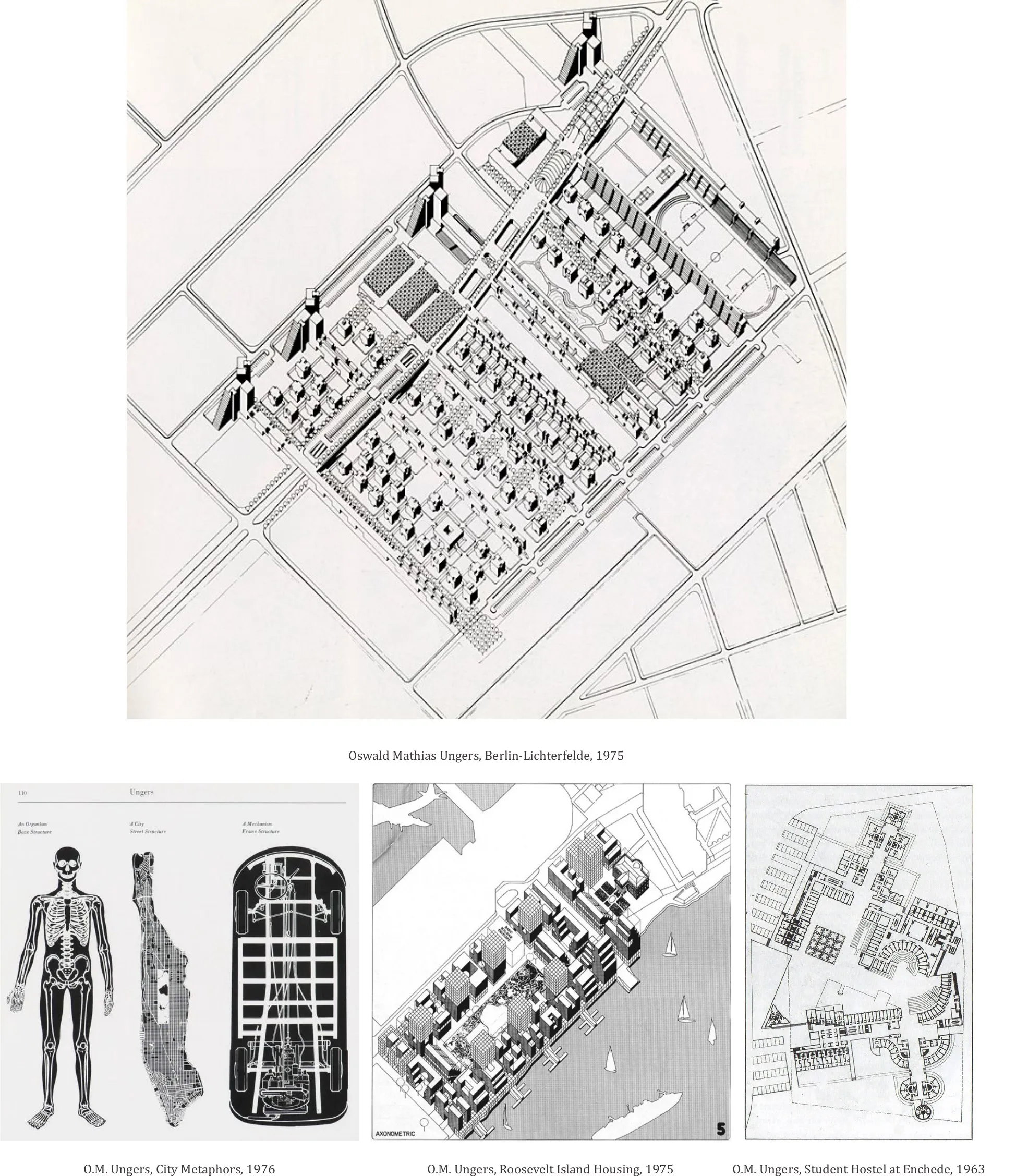
O.M. Ungers: A Survey for Urban Model
As described before, the studio aims to use the New Haven site as a test field for urban models. Our interest found its way to O.M. Ungers’ works, which repeatedly discussed the dialectic relationship between the whole and the part, the framework and the components, usually with the sweeping stroke of superimposed grids. His competition entry for Berlin-Lichterfelde drew analogy from the body to come up with a two-level hierarchy framework system (spine + rib), upon which buildings attach and are then mobilized. A universal grid dictates the placement of the buildings in relation to the framework. Similar approaches were seen in an array of projects, including the Rooselvelt Island Housing competition entry.
This model would lead to a system that privileges its internal cohesion and superimposition but neglects its context, which was rather evident in Ungers’ drawing preferences. Curiously, in his works such as the Enchede Studen Hostel, a more supple and reflective method was taken, as if mitigating between the colliding fields of forms into resolution, and to an large extent unshackling his own iron hold on the universal grid.
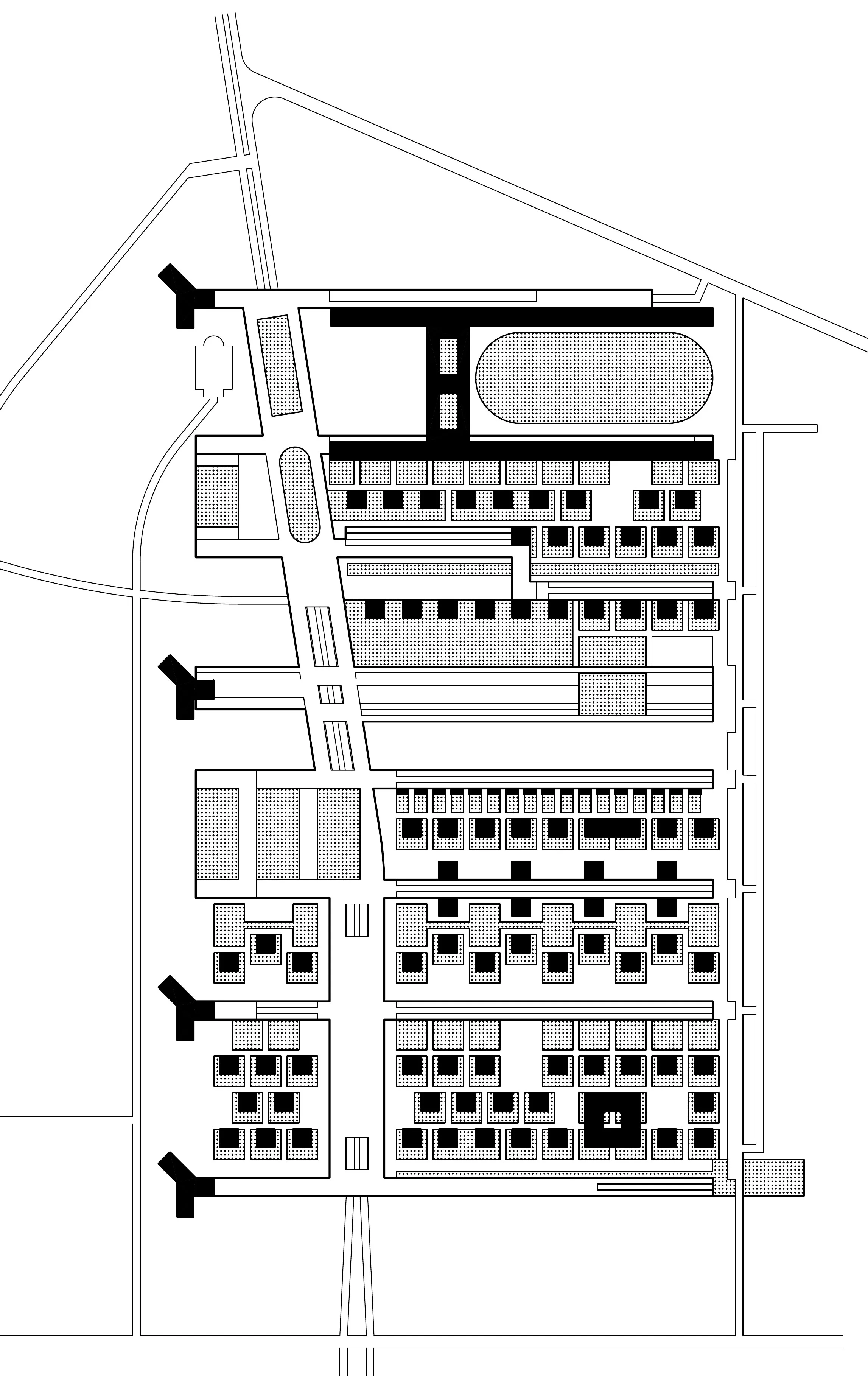
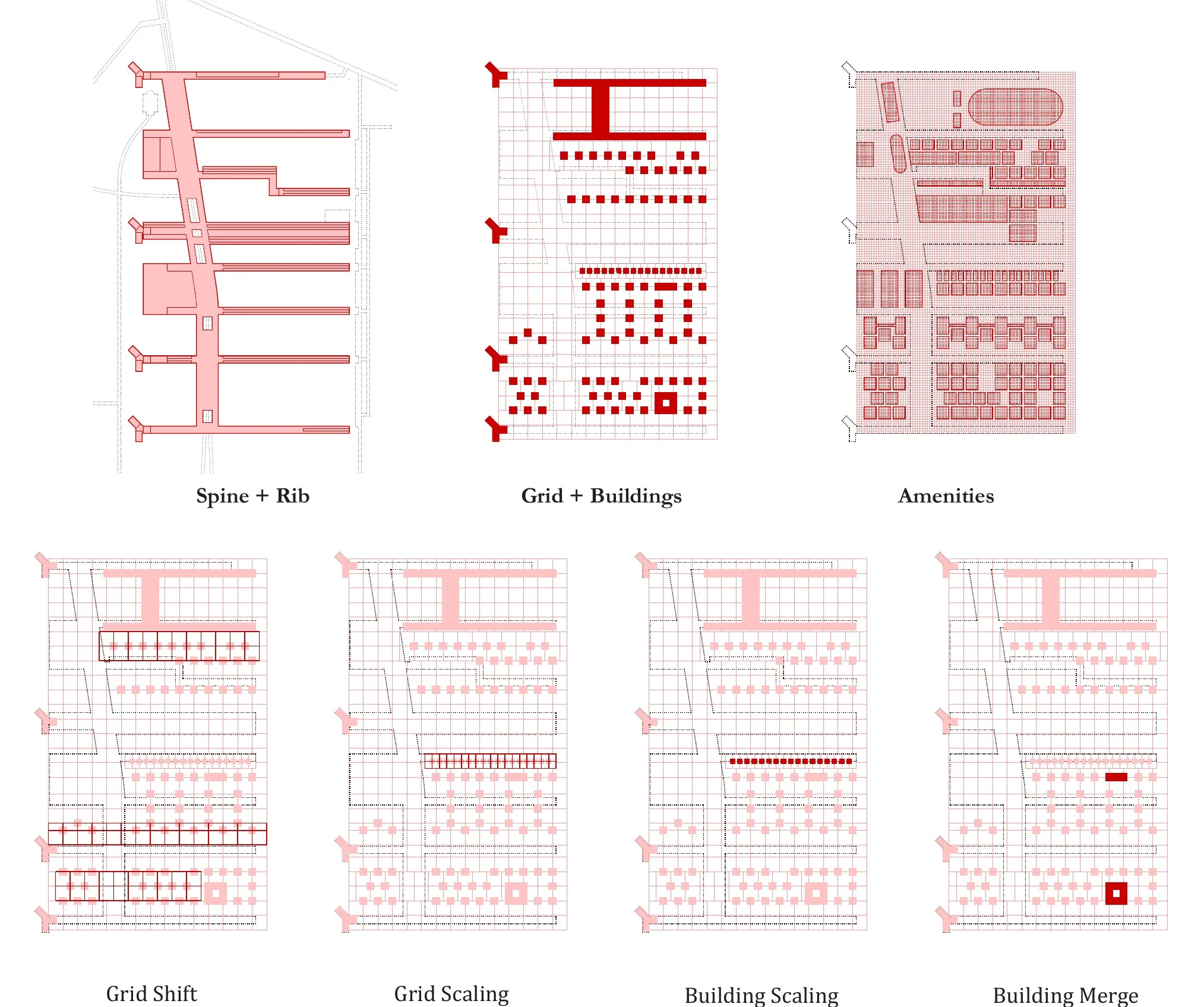
Extracting the Lichterfelde Model
We found the above thoughts both intriguing and relevant to our site: calling for cohesion, yet struggling with disparaty; in much need for structuring, yet relactant to self compatibility. After prolonged tests and experienments, Ungers and his urban model typified by his Lichterfelde competition entry, nicknamed “Framework Urbanism”, was selected as the subject of study for this project.
The first step of the study involves mapping and disassembling the various layers of the Lichterfelde model, unraveling its formal operations in a ostensible and rationalized protocal, for the purpose of being applied, and subsequently challenged on the given site of the New Haven Oak Street Connector site.
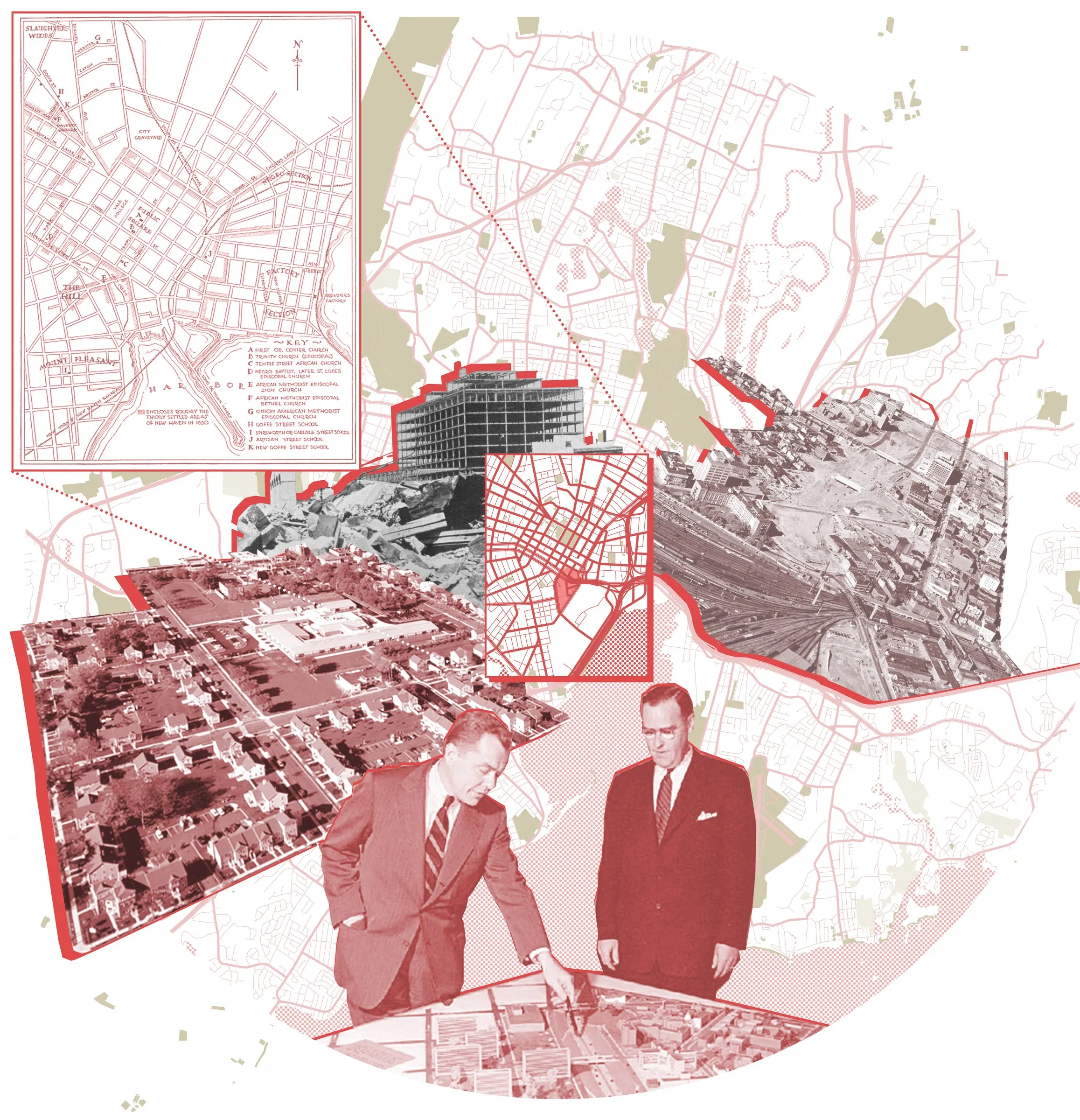
New Haven Oak Street Connector
Correcting an Urban Renewal Fiasco
Parrallel to the urban model survey, a study of the New Haven site was conducted. Originally conceived with the idealized Nine Square model in its inception, New Haven went though a period of dramatic urban renewal in the post-war period, led by Mayer Richard Lee, which has proven to be inequivocally unsuccessful. The urban renewal introduced the Route 34 highway through New Haven’s original texture, cutting the town apart and perpetuated the rapture between the downtown Nine Square plan and the vast housing neighborhood to the south of the highway connector. The unresolved, wrestling fabrics defined a triangular site at the focus of contension, which is selected as the studio project’s subject of study.
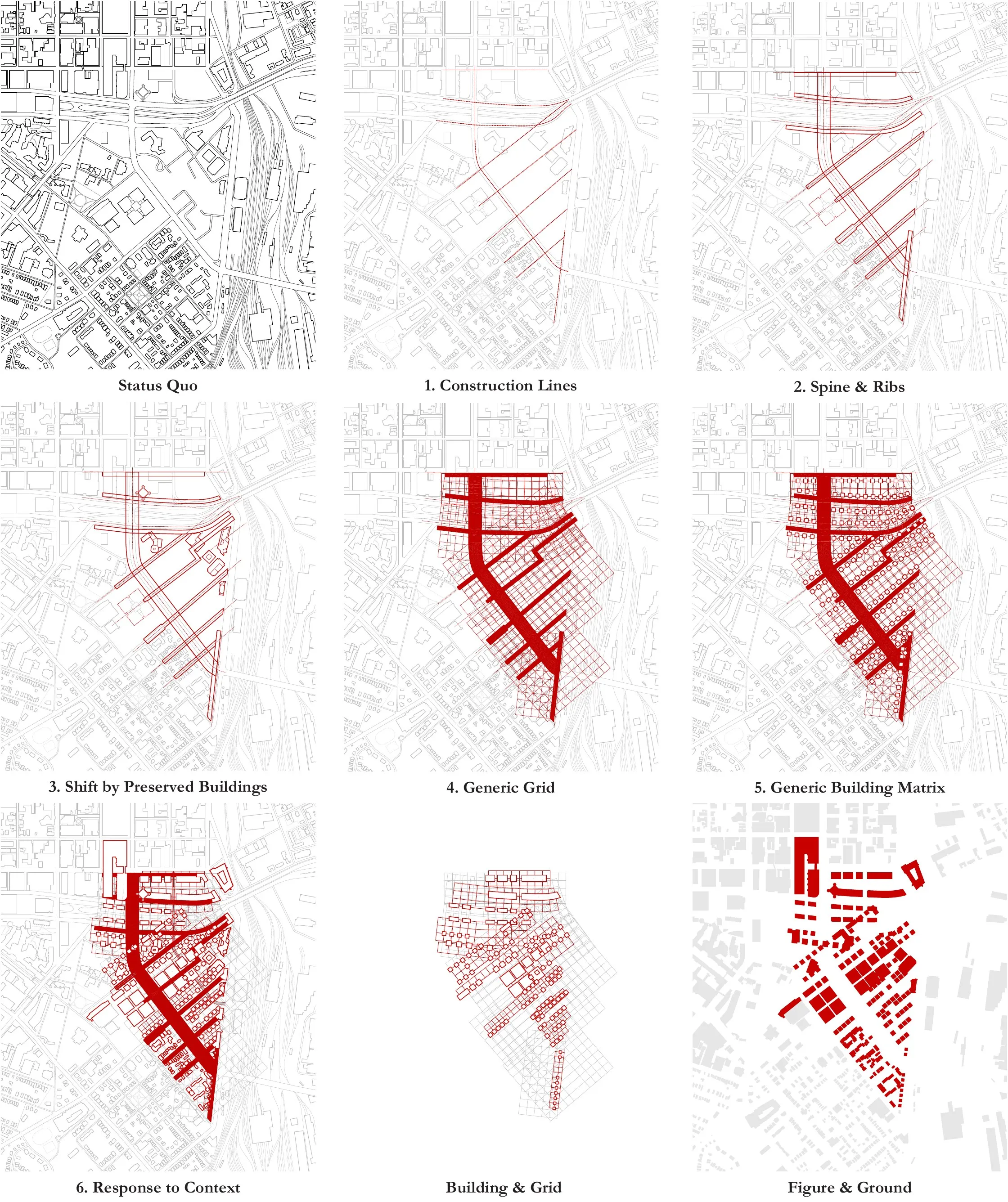
a). Using the site to deform the framework, instead of imposing an idealized organizational order.
b). Using church street as the spine to achieve cohesion between context and the project, instead of privileging its internal cohesion.
c). shifting the cell placement (the grids), allowing them to blend into the context, but nonetheless keeping their own identity.
d). Redefining the function of the spine and ribs as per the actuality of site conditions, thereby transposing the formal idea of the spine and rib into the organization of circulations on the urban site.
From “Model” to “Without a Model”
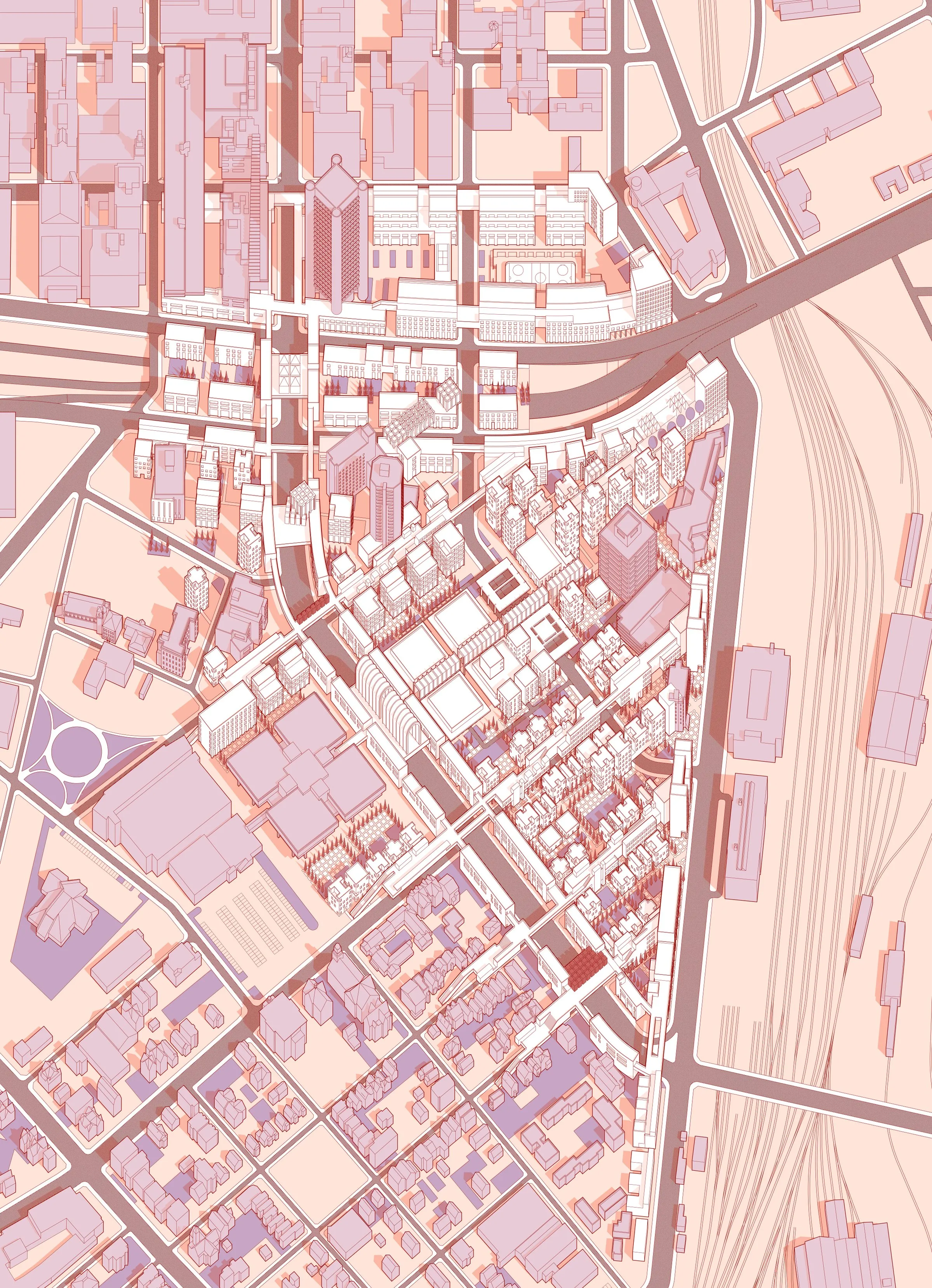
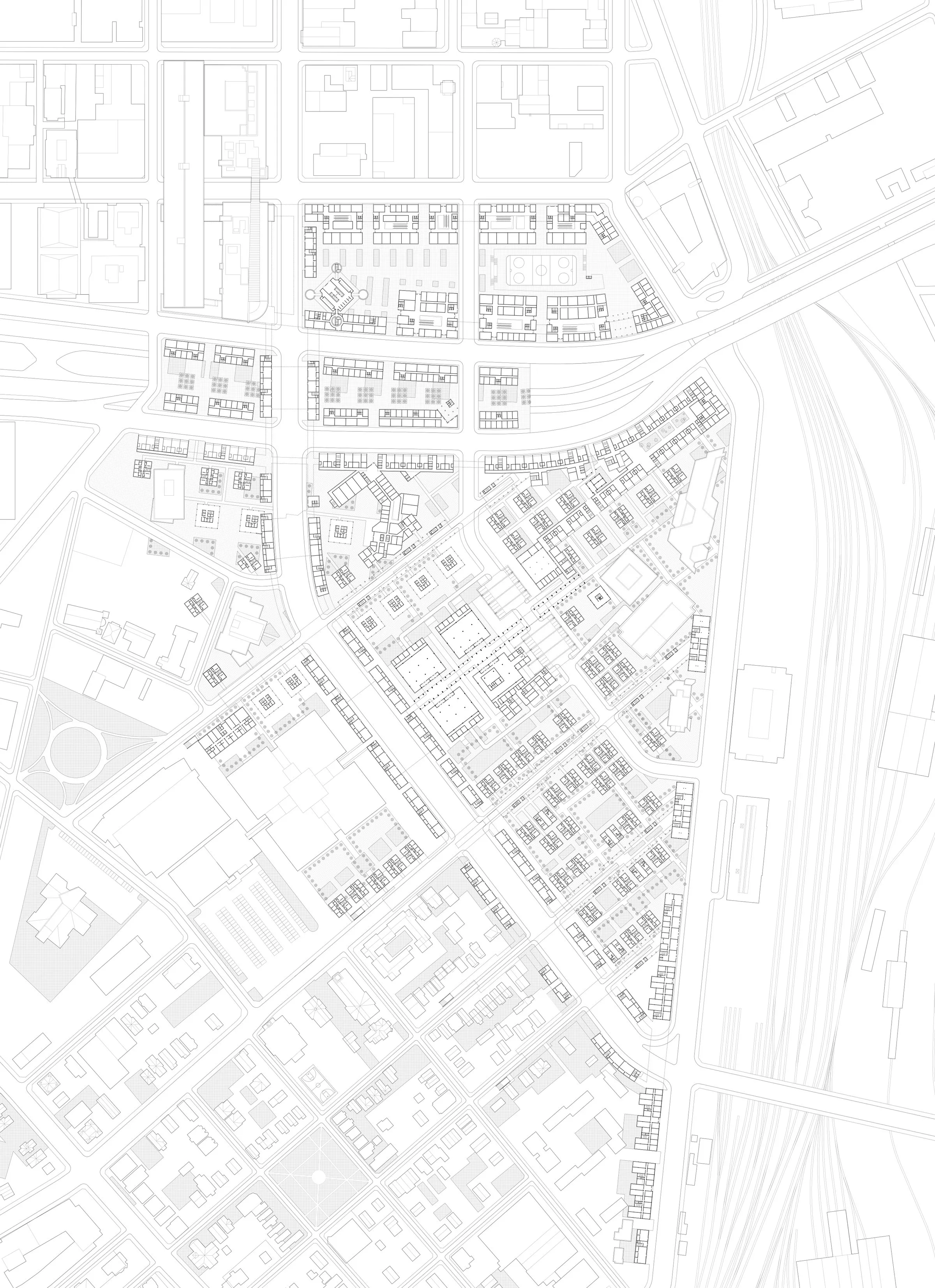
Upon delineating the Lichterfelde model, the model is applied to Oak Street Connector site to challenge its efficacy and impotency. As a critique to the Lichterfelde model’s introversion and totality, we opted to morph the universal grids and the framework prescribed thereon to the site’s actualies. The placement of the “spine” was dictated to be at the site’s boundary, with the “ribs” emitting, so that the framework is transformed from exclusivity to inclusivity. Most notably, this provides a leverage for contextualization of the building fabric contextualization.
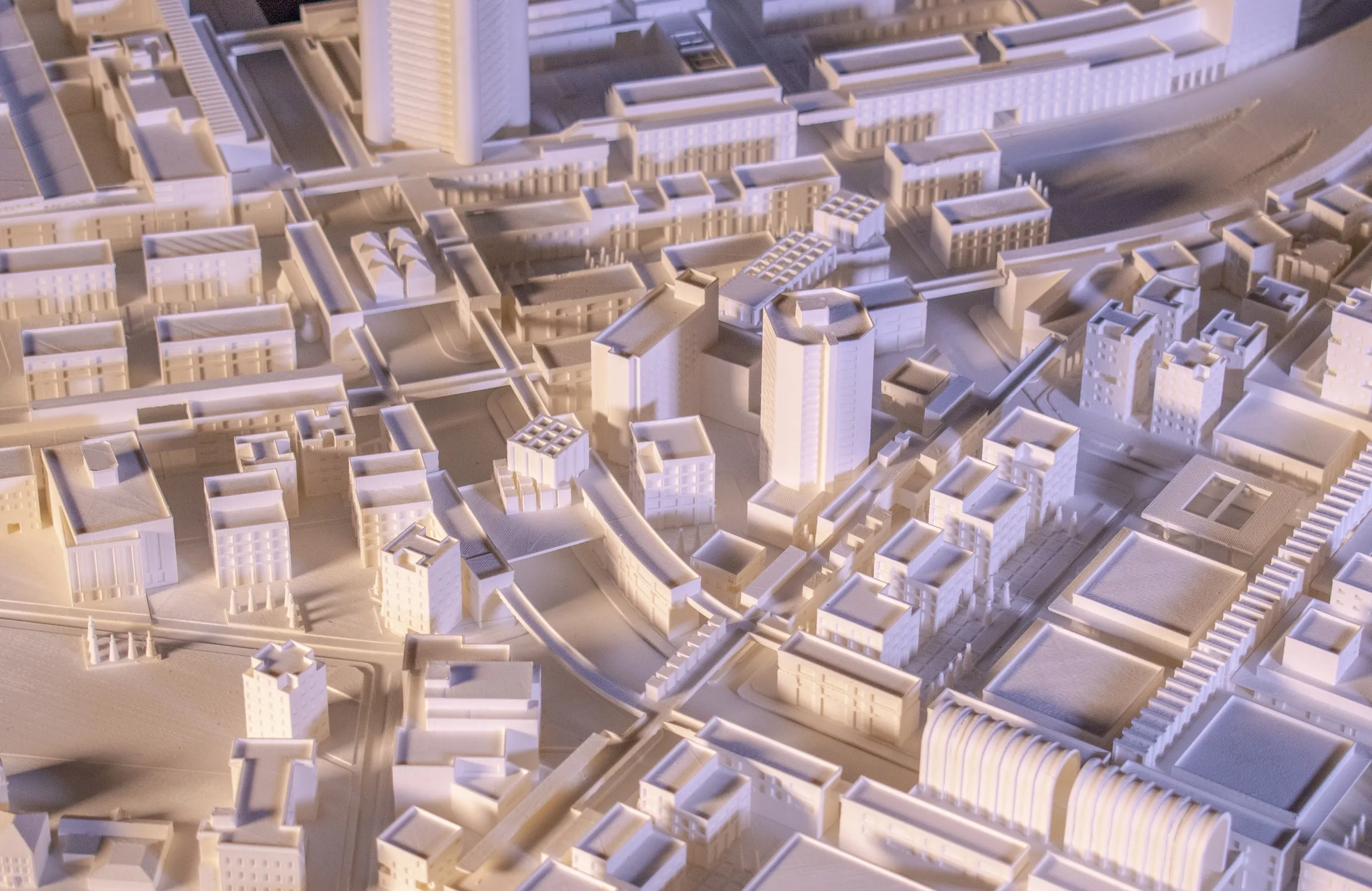
The edge bars on the north become mix-use development with retails and apartments.
The intermediate zone around the Oak Street Connector witnesses the tangling of two formal systems. A wide array of scale and place shift operations were applied to disintegrate the formal model’s rigidity into the context.
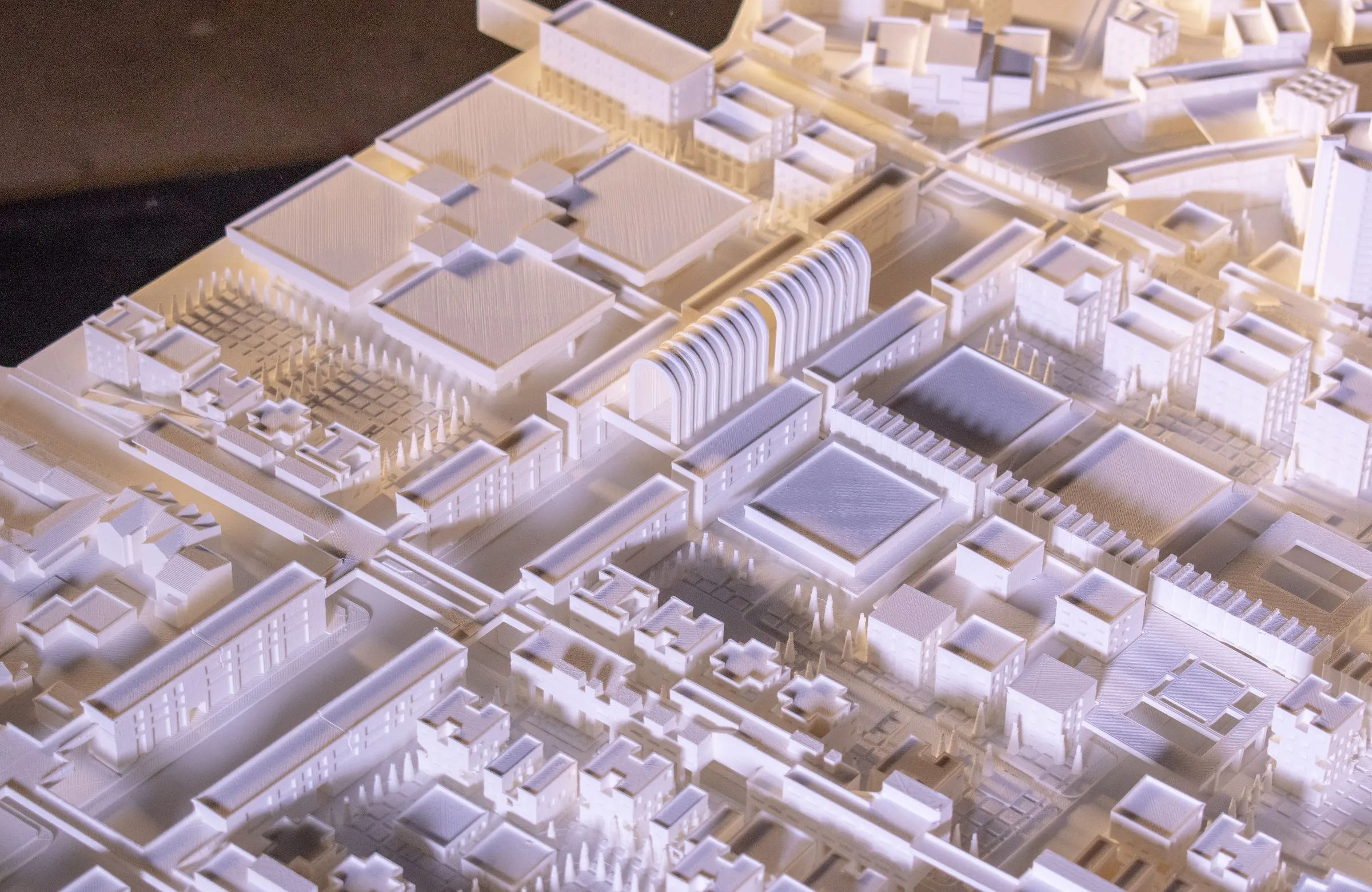
The spine becomes linear bars of street front retails framing Church St south into a corridor of urban life. They break down wherever appropriate, preventing a disregarding continuity.
The blocks mirroring the Richard Lee High school mega block break down in scale and becomes supermarkets.
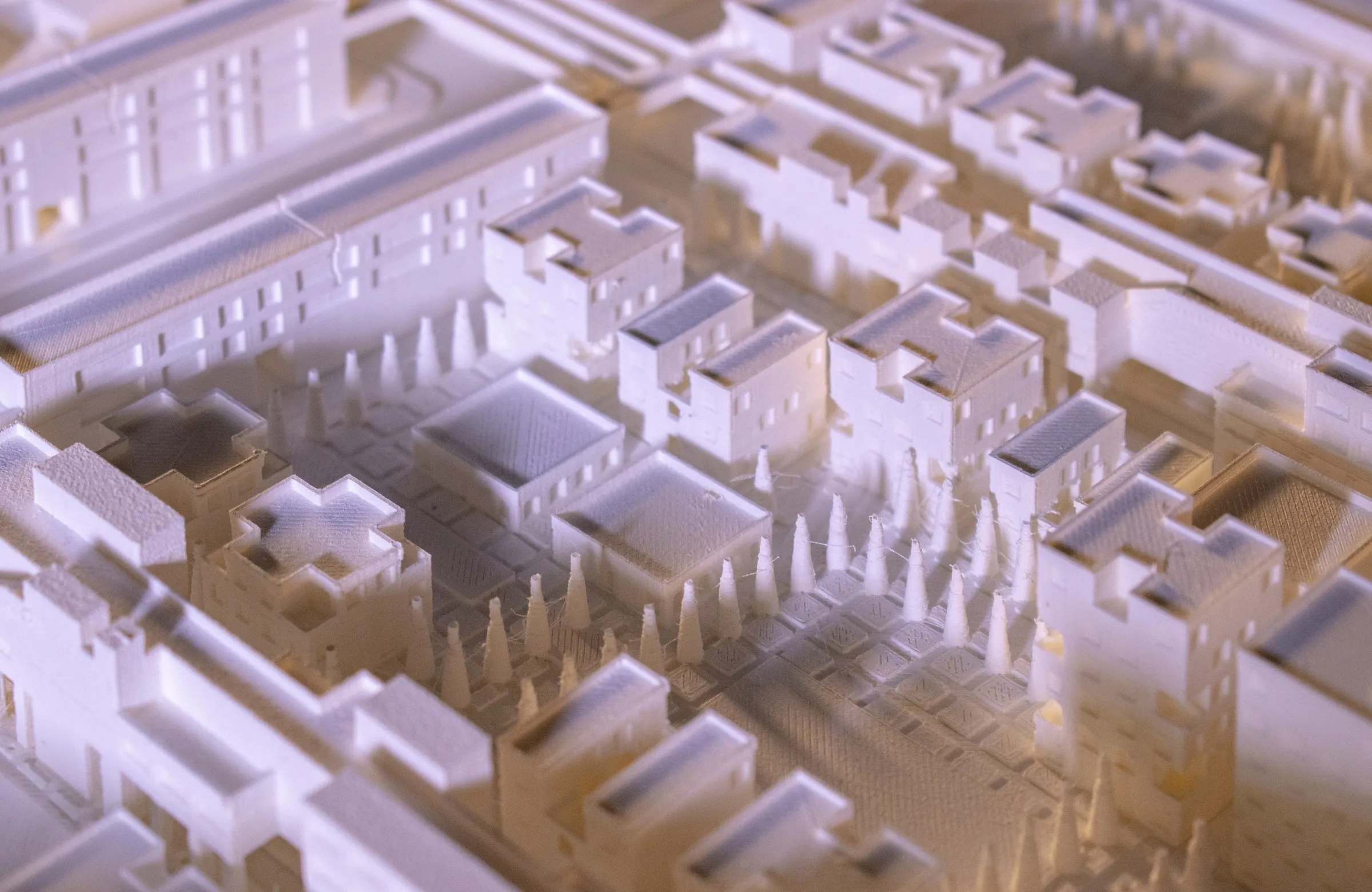
Model Vignettes
The ribs become elevated apartment buildings (on the site) and pedestrian bridge (across Church St). The cells are mostly housing units.
The context roads extend into the site under the ribs. The ribs break down locally to invite light, visibility, and events. People access the community via these framed pathways. The spaces between the ribs become leisure spaces for the community. People can also penetrate into them from the Church St street front retail buildings.
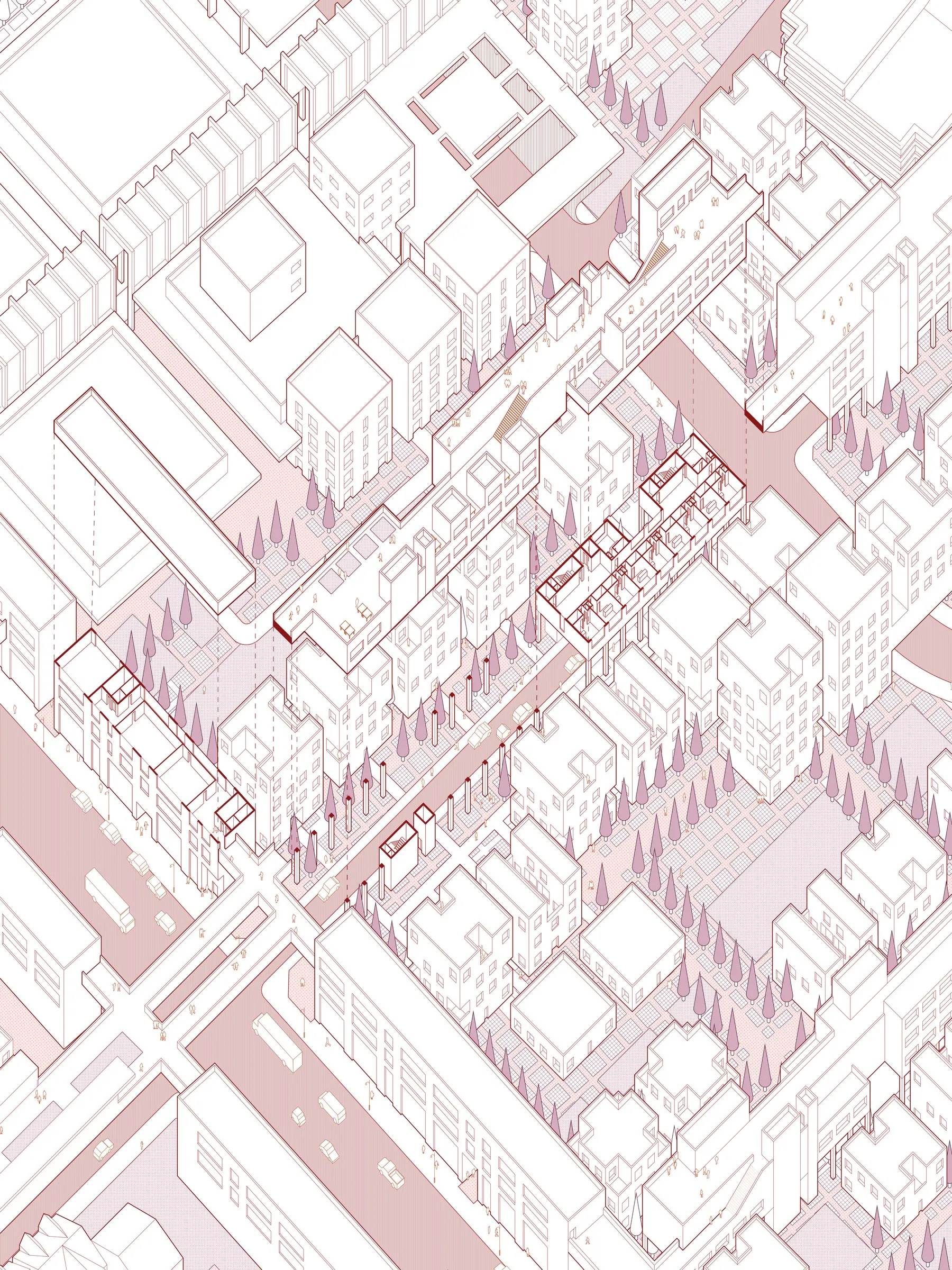
Community Axon